The range · Made in Bayswater, Melbourne · Delivery Australia wide
Timber Fascias & Barge Boards — Made to Suit Your Roofline
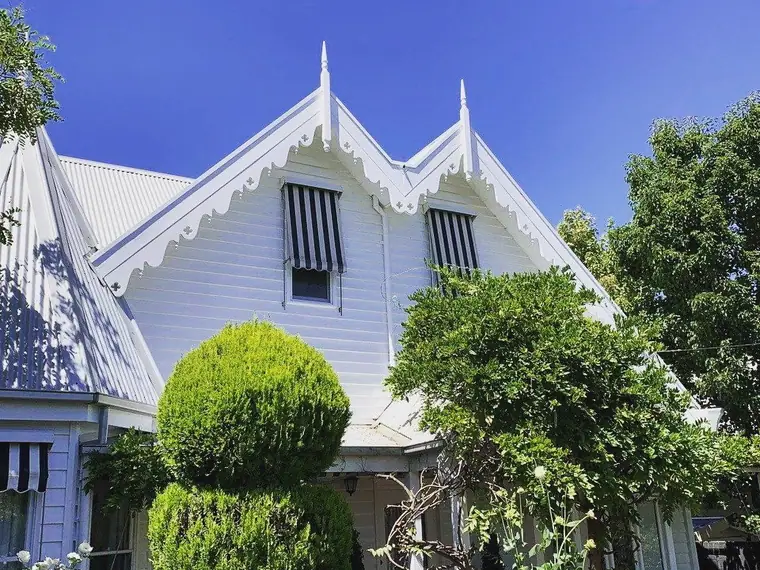
A fascia board runs horizontally along the eave and carries the gutter. A barge board runs up the rake of a gable end, where the roof oversails the wall. On a Victorian or Federation house neither is a plain board — both are deeper than a modern fascia and shaped along the exposed edge, which is what gives a period roofline its weight. Heritage & Decorative Timber Products makes both to your measurements, and match them to an existing profile.
Relief strips or fascia and barge boards?
For the DR1, DR2 and DR3 applied decorative patterns, compare decorative relief designs. For the roof-edge board itself and a profile made to match your home, see fascia and barge-board profiles.
Check decorative relief and BB3 barge-board pricing, or send an existing profile for a matching quote.
In the shop
The shop, and a quote when you need one.
420 products across 24 ranges are priced in the shop. Anything made to your own sizes is quoted — send us the measurements.
What you get
- Australian made — every product, made in our Bayswater workshop since 1984
- An answer within one business day — we reply to enquiries and quote requests
- In stock, or made in 1 to 4 weeks — some of the range is in stock; the rest is made to order
- Timber-profile matching — from a photograph, drawing or sample
What is the difference between a fascia and a barge board?
A fascia is the horizontal board fixed across the rafter ends along the eave. It closes off the roof, and it is what the gutter hangs from. A barge board is the sloping board on a gable end, following the pitch up to the apex, usually in pairs meeting at the top. The two are often shaped to the same pattern on the same house so they read as one detail, but they are cut, fixed and measured differently. Between the barge boards, the triangle itself is closed by a gable infill.
Why are period fascias not the same as modern ones?
A modern fascia is a plain, shallow board, sized to hold a gutter and nothing more. A period fascia is deeper, and its bottom edge is shaped rather than square, so it throws a shadow line along the eave. That depth is also what gives a decorative relief moulding somewhere to sit. Fitting a standard fascia to a period house is the commonest way a restored roofline ends up looking wrong from the street.
How is a fascia or barge board made to order?
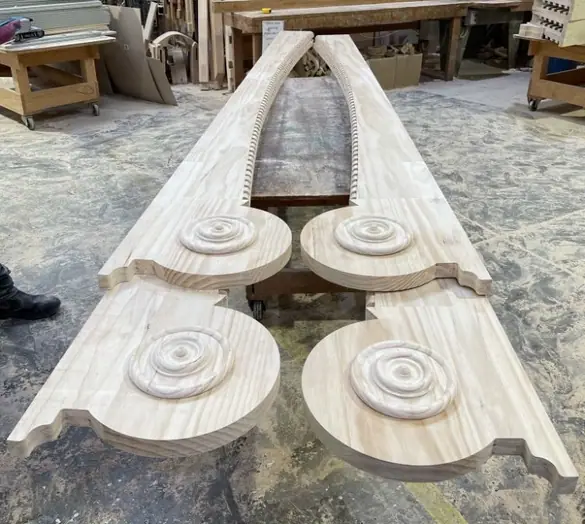
Every roof is different — the pitch differs, the overhang differs, and a century of settlement means the two sides of a gable rarely match — so fascias and barge boards are cut to your measurements rather than pulled from stock lengths. The standard barge board pattern is BB3, priced by the lineal metre. We cannot make one until we know the roof pitch, so that is the first number to have ready when you call.
What do I need to measure?
For a barge board: the length along the rake from the wall to the apex, the roof pitch, the depth of the board, and the shape of the end where it turns the corner. For a fascia: the run, the depth of the board, and whether it has to take a gutter bracket. Photograph the roofline square-on with a tape measure in shot. The period verandah parts guide shows how fascias, barge boards and rafters relate, so you can identify the piece to be replaced.
Can you match an existing fascia profile?
Yes — matching is most of this work. Send an offcut where you can, or a clear photograph of the shaped edge. Ask about our timber-profile matching service. Everything is made in Australia and delivered to your home or site, and quotes are free.
What timber are they made from, and is the guarantee included?
Our fascias and barge boards are made from LOSP H3 treated pine — the hazard class for timber used outdoors, above ground, exposed to weather but out of soil contact. LOSP is a solvent-borne treatment, so the board stays dimensionally stable and holds a crisp shaped edge, which is what a scalloped barge board depends on. As external LOSP H3 treated pine used above ground, our fascias and barge boards carry our 25 year guarantee.
Decorative relief is the exception. Our DR range is made from treated marine ply, not LOSP H3 treated pine, so the 25 year guarantee does not extend to it. The sizes, patterns and fixing details for decorative relief are set out on our decorative relief and barge boards page.
How should they be finished?
Apply two thin coats of oil-based primer to all six sides before installation, including the back and both cut ends — LOSP treatment needs an oil-based primer to bond properly. Keep the boards dry, and leave them 72 hours after delivery to acclimatise before painting. Two to three thin topcoats after that, in acrylic, water-based or oil-based paint. Call 03 9720 1996.
Related pages
The range
Product photographs and profile drawings.
4 scale profiles · 4 product codes. Select any one to see it larger.
Scale profiles
Talk to the workshop
Tell us the code and the size.
- Workshop852 Mountain Highway, Bayswater VIC 3153
- DeliveryAustralia wide