The range · Made in Bayswater, Melbourne · Delivery Australia wide
Timber Arches — Internal & External Arched Fretwork
Arched timber fretwork is a decorative panel for a hallway opening or the space between verandah posts. Heritage & Decorative Timber Products makes internal hall fretwork with an MDF insert and clear pine frame, and external arched fretwork in LOSP H3 treated pine for above-ground use. Choose the location before the pattern: these are different material specifications within our fretwork and frieze range.
In the shop
The shop, and a quote when you need one.
420 products across 24 ranges are priced in the shop. Anything made to your own sizes is quoted — send us the measurements.
What you get
- Australian made — every product, made in our Bayswater workshop since 1984
- 25 year guarantee — on external LOSP H3 treated pine, above ground
- An answer within one business day — we reply to enquiries and quote requests
- In stock, or made in 1 to 4 weeks — some of the range is in stock; the rest is made to order
- Timber-profile matching — from a photograph, drawing or sample
What is the difference between internal and external arched fretwork?
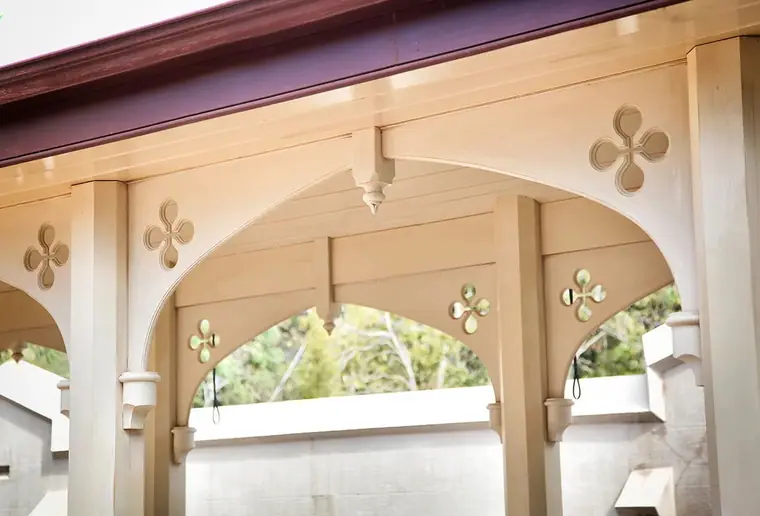
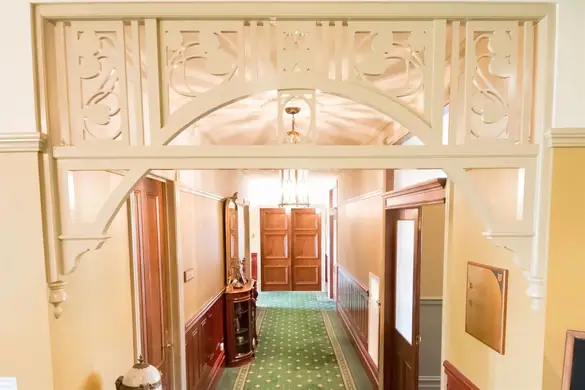
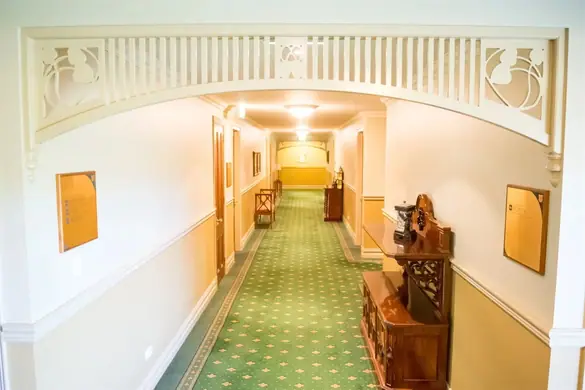
Internal fretwork fills the top of a hallway or doorway opening; external fretwork is an arched panel with a shaped bottom rail, fixed between verandah posts under the beam. Both are photographed separately — inside the house, across a hallway, and outside, between the posts of a verandah. The internal panel never sees rain, so it is MDF in a pine frame, finished to match your joinery. The external panel is weather-exposed, so it is LOSP H3 treated pine.
Which internal hall arch patterns do you make?
Our internal fretwork is the HFR range, named for the Victorian hall arch, HFR1. Nineteen designs are drawn: HFR1 to HFR5, HFR8 to HFR19, plus DFR10 and DFR11. Every one is drawn at 2,690 x 1,230mm and scaled to your opening rather than cut down from a fixed panel. They are priced by the lineal metre, with a minimum charge of 1.5 metres wide.
Use the internal fretwork visualiser to choose a pattern, enter the clear width and height of your own opening, and compare how each design changes at those proportions before the workshop cuts it. Check the priced internal fretwork selection; ask the workshop to quote a pattern that is drawn in the visualiser but not listed in that selection.
What is internal fretwork made from?
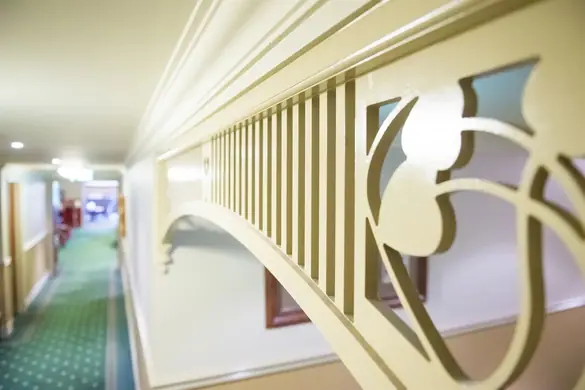
An internal hall arch is cut from 18mm MDF and set into a pine frame of 65 x 32mm. Because the frame is clear — that is, untreated — pine, the insert is MDF, and the panel never sees weather, internal fretwork is not covered by our external timber guarantee. They are made to be painted or finished to match existing joinery.
What external arched fretwork do you make?
Outside, an arch is a fretwork panel carried on a shaped bottom rail, and the rail is what distinguishes them:
- FR1 arched — a 90 x 65mm bottom rail with dentil mould worked to both faces; the heaviest of the three.
- FR4 arched — with or without a decorative motif (motifs A to G), on a 42 x 42mm dressed arched bottom rail trenched 19 x 12mm to receive the fretwork.
- FR4 arched dentil — a 70 x 42mm bottom rail with dentil mould to one face only, for arches seen from the street side.
All external fretwork is LOSP H3 treated pine, and as external LOSP H3 treated pine used above ground it carries our 25 year guarantee.
How do I measure an arched panel?
Three numbers order an arched panel. First, the clear width: from the inside face of one post or jamb to the inside face of the other, taken at more than one height, because old posts bow. Second, the side drop — how far the timber comes down alongside each upright, setting where the curve begins. Third, the centre drop — how far the arch dips at the middle. Together those two describe the sweep. Label all measurements in millimetres and show where each measurement starts and ends on a photograph or drawing. Photograph the opening square-on with a tape measure in shot. If you use the fretwork visualiser, confirm the pattern, material and final opening dimensions with the workshop; a design preview is not a measured site template.
How should an arch be finished?
External fretwork takes two thin coats of oil-based primer on all six faces before fixing, because LOSP treatment is solvent-borne and only an oil-based primer bonds to it. Let the timber acclimatise for 72 hours after delivery, keep it dry, then two to three thin topcoats, and inspect annually. Internal fretwork takes normal interior paint or stain.
Can you copy an arch I already have?
Send a section of the original — nothing matches like the real thing. Ask about our timber-profile matching service. Australian made, delivered Australia-wide. Call 03 9720 1996.
Related pages
The range
Product photographs and profile drawings.
1 photographed · 1 product code. Select any one to see it larger.
Photographed
In place
On real houses, in Australia.
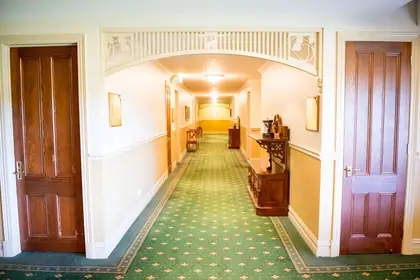
Timber arch, internally - view 3 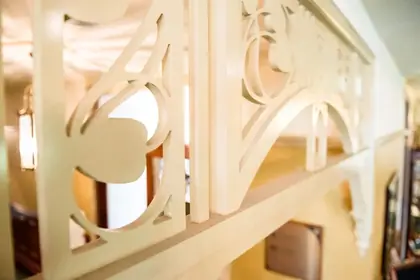
Timber arch, internally - view 4 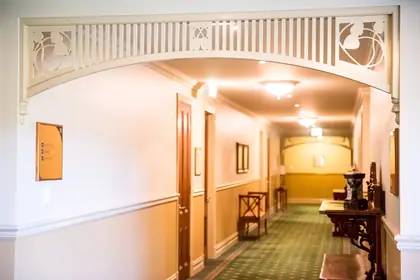
Timber arch, internally - view 5 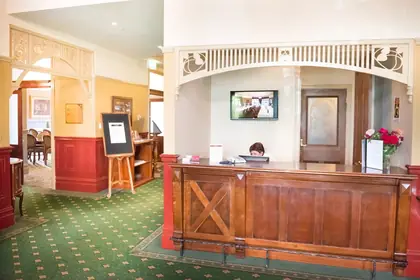
Timber arch, internally - view 6 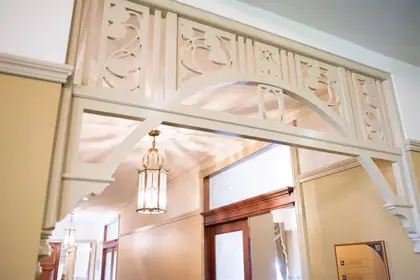
Timber arch, internally - view 7 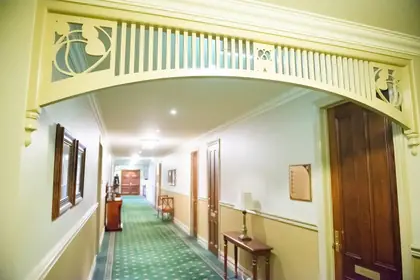
Timber arch, internally - view 8 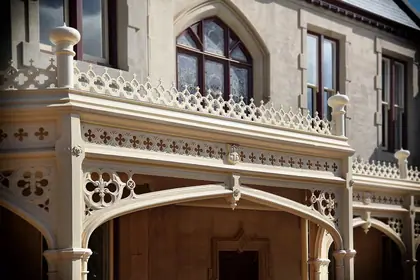
Timber arch, externally 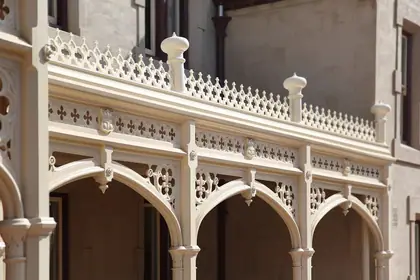
Timber arch - external timber arch on a period verandah 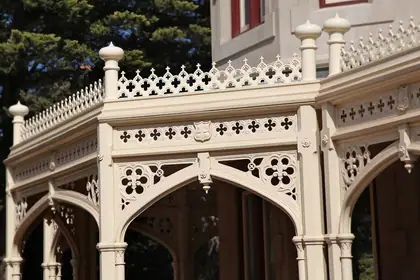
Timber arch, externally - view 2 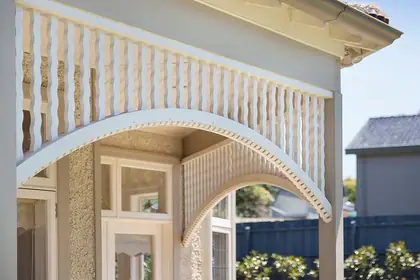
Timber arch, externally - view 3 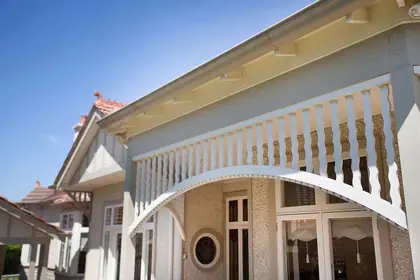
Timber arch, externally - view 4 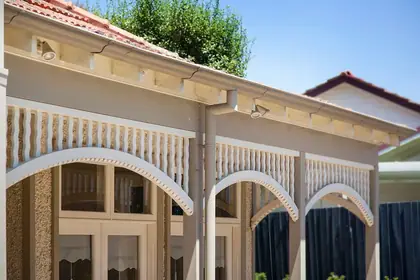
Timber arch, externally - view 5 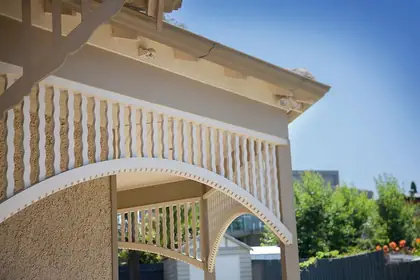
Timber arch, externally - view 6 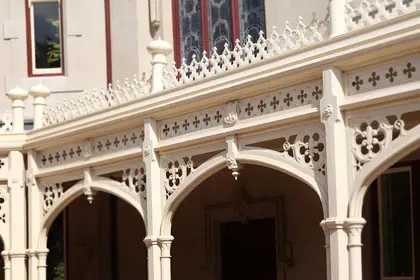
Timber arch, externally - view 7 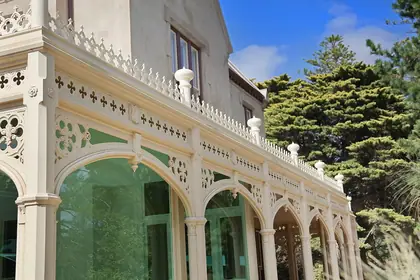
Timber arch, externally - view 8 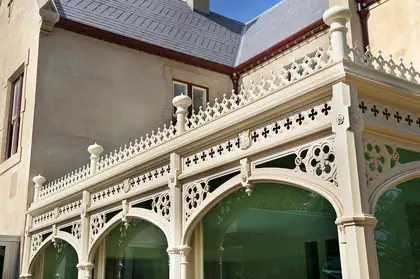
Timber arch, externally - view 9 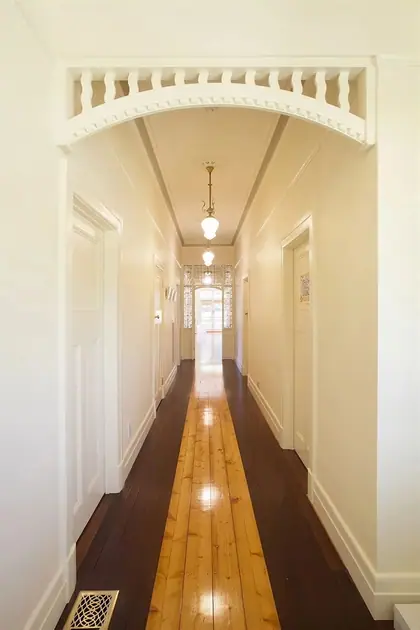
Timber arch, internally - view 9 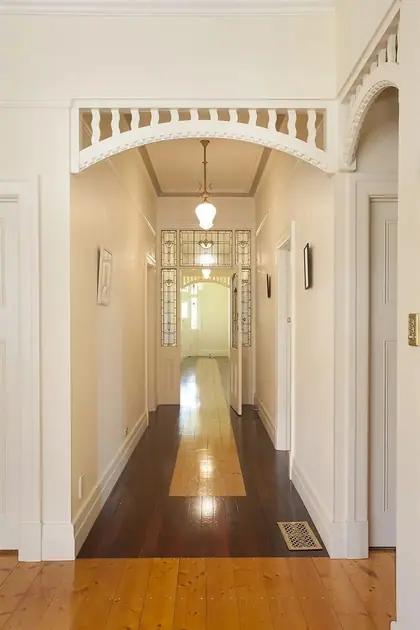
Timber arch, internally - view 10 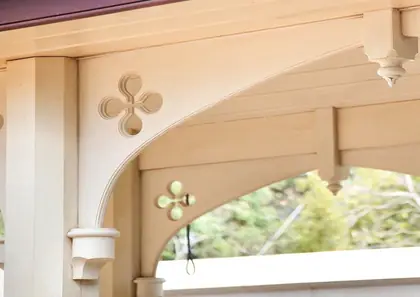
Timber arch, over an arched opening in close-up
Talk to the workshop
Tell us the code and the size.
- Workshop852 Mountain Highway, Bayswater VIC 3153
- DeliveryAustralia wide
Product and ordering questions
How do I measure for a timber arch?
Three numbers order an arch. Measure the clear width from the inside face of one post or jamb to the inside face of the other, taking it at more than one height if the timbers are old and may have bowed. Then measure the side drop, how far the timber comes down alongside each upright, and the centre drop, how far the arch dips at the middle of the opening.
What is the difference between an internal and an external timber arch?
An internal hall arch is a panel set into a pine frame and is made to be painted or finished to match existing joinery; it never sees weather. An external arch is an arched fretwork panel on a shaped bottom rail, made from LOSP H3 treated pine.
Are internal arches covered by the 25 year guarantee?
No. Internal arches are a pine frame with an MDF insert and never see weather, so they are not covered by the external timber guarantee. The guarantee applies to external LOSP H3 treated pine used above ground.